
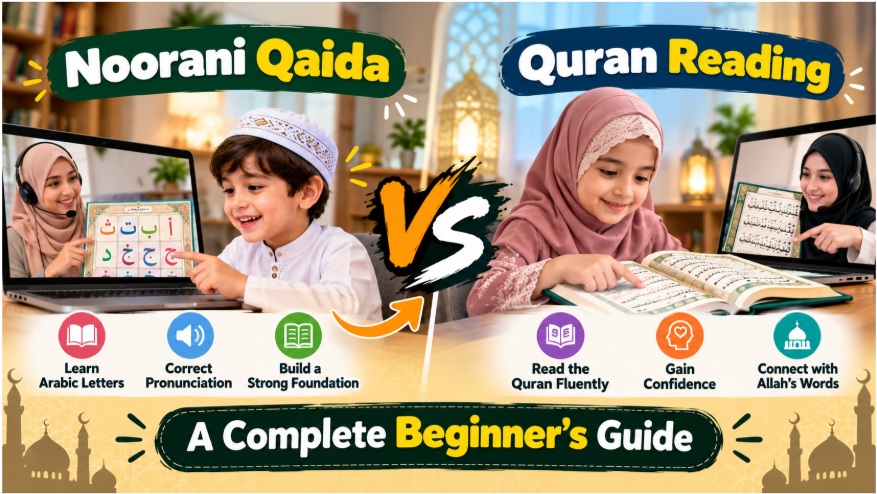
Learning to read the Holy Quran is an important milestone in the life of a Muslim, especially for young children who are just starting their Islamic education. But many parents are confused about where to begin. Should they start with Noorani Qaida, or can they start reading the Quran directly?
If parents understand the difference between Noorani Qaida and Quran reading, they will be able to select the most suitable learning path for their children.
These two are important phases in the process of teaching the Quran, but they serve different purposes. In Noorani Qaida, students learn the principles of Arabic pronunciation and reading, whereas in Quran reading, students learn to apply these basic principles to recite the Holy Quran correctly and fluently.
What Is Noorani Qaida?
Noorani Qaida is an educational book designed for beginners to help them learn the basics of reading Quranic Arabic. It teaches students the Arabic alphabet, how to read words properly, and the basic rules of pronunciation.
It is especially beneficial for young children and non-Arabic-speaking individuals who have little or no experience with the Arabic language.
Usually, students first learn to recognize individual Arabic letters and then learn how these letters are connected to form words.
What Is Taught in Noorani Qaida?
A typical Noorani Qaida course consists of:
- Identification of the Arabic alphabet and proper pronunciation of sounds.
- Understanding Harakat (Fatha, Kasra, and Damma).
- Learning Sukoon, Shaddah, and Tanween.
- Recognizing connected forms of Arabic letters and word formation.
- Practicing Madd letters and basic pronunciation rules.
- Basic guidance in the fundamentals of Tajweed.
A qualified teacher helps students pronounce each letter correctly from its proper articulation point, called Makhraj.
The goal isn’t just to learn letters but to learn how to accurately recognize and pronounce Arabic words.
What Is Quran Reading?
The next phase of learning is Quran reading, in which students start reading the verses of the Holy Quran.
Once students have learned the basic skills from Noorani Qaida, they begin to put these skills to use when reading Quranic words, sentences, and complete verses.
Noorani Qaida focuses on individual reading rules, while Quran reading involves applying these rules during continuous recitation.
Students gradually recognize words more easily, connect verses smoothly, and develop their pronunciation skills.
What Skills Do Students Acquire in Quran Reading Classes?
Usually, Quran reading lessons emphasize:
- Reading Quranic verses from the Mushaf.
- Applying Tajweed rules during recitation.
- Developing fluency and pronunciation.
- Identifying appropriate stopping and starting points.
- Confidently reading longer verses.
- Forming the habit of regularly reciting the Quran.
An experienced Quran teacher monitors students’ reading and corrects mistakes to help them develop accuracy.
What Is the Difference Between Noorani Qaida and Quran Reading?
The most important difference lies in their learning goals.
Noorani Qaida is used to teach students how to read Quranic Arabic, while Quran reading teaches them to apply those skills when reading the Holy Quran.
Let’s make a simple comparison:
| Feature | Noorani Qaida | Quran Reading |
| Learning level | Beginner | After basic reading skills |
| Main purpose | Develop Arabic reading skills | Read Quranic verses correctly |
| Learning material | Noorani Qaida book | Holy Quran |
| Primary focus | Letters, sounds, and basic rules | Fluency, recitation, and Tajweed |
| Teaching method | Step-by-step exercises | Guided verse reading |
| Suitable for | Beginners and children | Students with basic Arabic reading skills |
Both stages go hand in hand and help to build excellent Quran recitation skills.
Why Is It Important for Children to Learn Noorani Qaida Before Quran Reading?
A strong foundation is important for successful Quran education.
If children start reading the Quran without understanding Arabic letters and pronunciation rules, they may struggle to read correctly or develop incorrect reading habits.
Noorani Qaida helps reduce these problems by teaching important concepts gradually.
1. Develops Good Arabic Pronunciation
There are some letters in Arabic that may sound similar to beginners but have different articulation points.
In Noorani Qaida lessons, children learn to differentiate these sounds before reading complete Quranic verses.
2. Makes Quran Reading Easier
If students are confident with letter combinations, vowel marks, and basic reading rules, they will be able to read Quranic text with greater confidence.
This can make the transition from individual words to complete verses smoother.
3. Teaches Essential Tajweed Rules
Tajweed is important for the correct pronunciation of the Quran.
In Quran reading classes, students practice and develop the foundational Tajweed concepts introduced in Noorani Qaida.
4. Develops Confidence in Young Learners
Teaching Arabic letters in small steps enables children to experience a sense of achievement.
These accomplishments can inspire students and encourage them to continue studying the Quran.
How Long Does It Take to Complete Noorani Qaida?
The duration of a Noorani Qaida course depends on the student’s age, learning ability, class frequency, and practice routine.
Some children can complete the course in a few months, while others may need more time to improve their pronunciation and reading skills.
Parents need to understand that completing Noorani Qaida quickly doesn’t necessarily mean that the child has learned it successfully.
What is more important is ensuring that the child understands the lessons and can apply them without assistance.
This is when regular revision, patient teaching, and one-on-one attention are especially helpful.
How Does an Online Quran Academy Teach Noorani Qaida and Quran Reading?
In the modern era, children and adults can study with qualified teachers without having to travel to a physical school through online Quran education.
A professional online Quran academy usually follows a structured teaching approach. Lessons are generally designed according to the student’s previous knowledge and learning level.
Noorani Qaida lessons are taught to beginners, while students who already recognize Arabic letters can be assessed before starting Quran reading.
Personalized One-on-One Classes
Individual lessons give teachers the opportunity to identify pronunciation errors and modify instruction based on each student’s progress.
Live Pronunciation Correction
In interactive classes, teachers listen to students reading Arabic letters or Quranic verses and provide immediate feedback.
Flexible Learning Schedules
Online classes may help parents balance their children’s Quran education with school activities and family responsibilities.
Regular Progress Assessments
Teachers can assess when students are ready to advance from Noorani Qaida to reading the Quran itself.
When selecting an online Quran academy, it is important to look for a reliable platform that offers experienced instructors to help learners establish a solid foundation in their Quran studies.
Can Students Start Reading the Quran Without Noorani Qaida?
Yes, students with the necessary Arabic reading skills can start reading the Quran without having to complete a full Noorani Qaida course.
For instance, if a child has already learned Arabic letters and basic reading rules, they may be ready to read directly from the Quran.
However, for complete beginners, it is generally better to learn Noorani Qaida first.
A qualified Quran teacher should evaluate the student’s pronunciation, letter recognition, and reading skills before deciding which course to recommend.
The aim is to ensure that students learn correctly without moving ahead before they are ready.
How Can Parents Help Their Children Learn the Quran?
Parents can play a significant role in reinforcing their children’s Quran learning routines.
Encouraging a few minutes of daily revision, listening to their child’s recitation, and maintaining regular contact with the teacher can help ensure steady progress.
Parents should also avoid comparing their child’s learning pace with that of other children.
Each child has unique abilities, and a supportive learning environment fosters a lifelong interest in learning the Quran.
Conclusion: Noorani Qaida or Quran Reading – Which Should Come First?
It is important for parents to understand the difference between Noorani Qaida and Quran reading, as this enables them to make informed decisions about their children’s Quran education.
Noorani Qaida provides a fundamental introduction to the Arabic alphabet, pronunciation, and basic reading rules. Quran reading develops these abilities by enabling students to recite the Holy Quran accurately and confidently.
Noorani Qaida is the best starting point for most beginners.
Correct pronunciation, consistent practice, and gradual improvement are important, whether your child is studying at home or through an online Quran academy.
A good start can help boost children’s confidence and develop the skills needed to maintain a lifelong connection with the Holy Quran.


